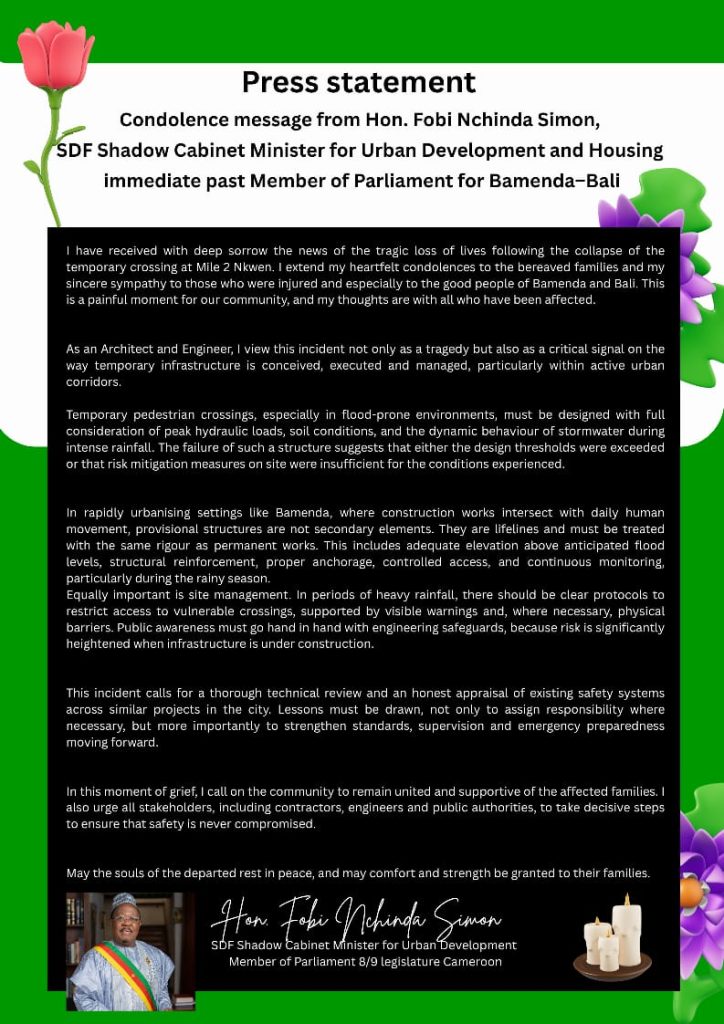

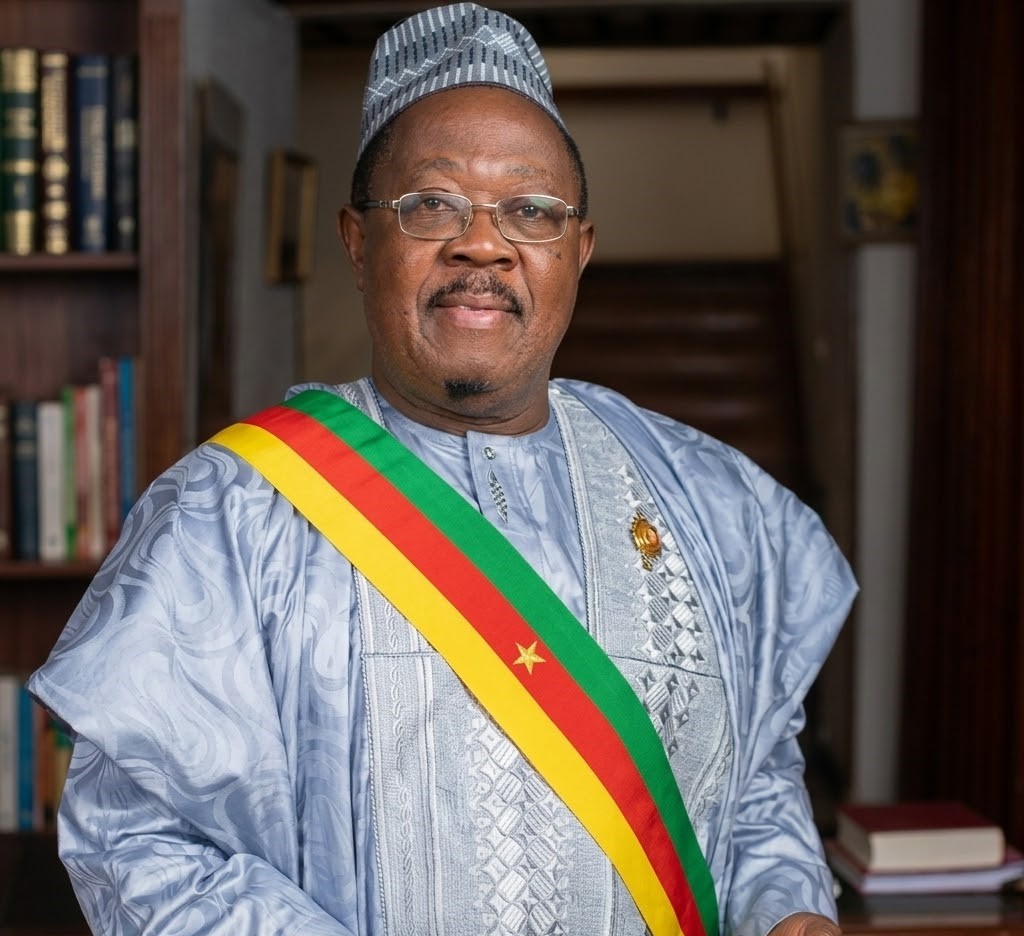
The Former member of parliament For Bamenda-Bali (8/9 legislature) and current SDF Shadow Cabinet Minister for Urban Development and Housing, the Hon Fobi Nchinda Simon has called for “a thorough technical review and an honest appraisal of existing safety systems” in projects being executed in Bamenda. This is contained in a press statement he released on Thursday April 2, 2025 in light of the tragic incident at the site of the Mile II Bridge Nkwen, where a temporary Pedestrian crossing gave way under heavy rains claiming at least 5 lives on March 26, 2026.
He said “Lessons must be drawn, not only to assign responsibility where necessary, but more importantly to strengthen standards, supervision and emergency preparedness moving forward”
He also extends his “heartfelt condolences to the bereaved families” and his “sincere sympathy to those who were injured and especially to the good people of Bamenda and Bali” adding “my thoughts are with all who have been affected”
His statement goes further to state that “As an Architect and Engineer, I view this incident not only as a tragedy but also as a critical signal on the way temporary infrastructure is conceived, executed and managed, particularly within active urban corridors”
Hon. Fobi said “temporary pedestrian crossings, especially in flood-prone environments, must be designed with full consideration of peak hydraulic loads, soil conditions, and the dynamic behaviour of stormwater during intense rainfall. The failure of such a structure suggests that either the design thresholds were exceeded or that risk mitigation measures on site were insufficient for the conditions experienced.”
The statement further goes to state that “in rapidly urbanising settings like Bamenda, where construction works intersect with daily human movement, provisional structures are not secondary elements. They are lifelines and must be treated with the same rigour as permanent works. This includes adequate elevation above anticipated flood levels, structural reinforcement, proper anchorage, controlled access, and continuous monitoring, particularly during the rainy season”
His statement also advises that site management should be taken seriously “In periods of heavy rainfall, there should be clear protocols to restrict access to vulnerable crossings, supported by visible warnings and, where necessary, physical barriers. Public awareness must go hand in hand with engineering safeguards, because risk is significantly heightened when infrastructure is under construction”
The statement ends with a call on the “community to remain united and supportive of the affected families.” while also urging “all stakeholders, including contractors, engineers and public authorities, to take decisive steps to ensure that safety is never compromised”